Quick Answer
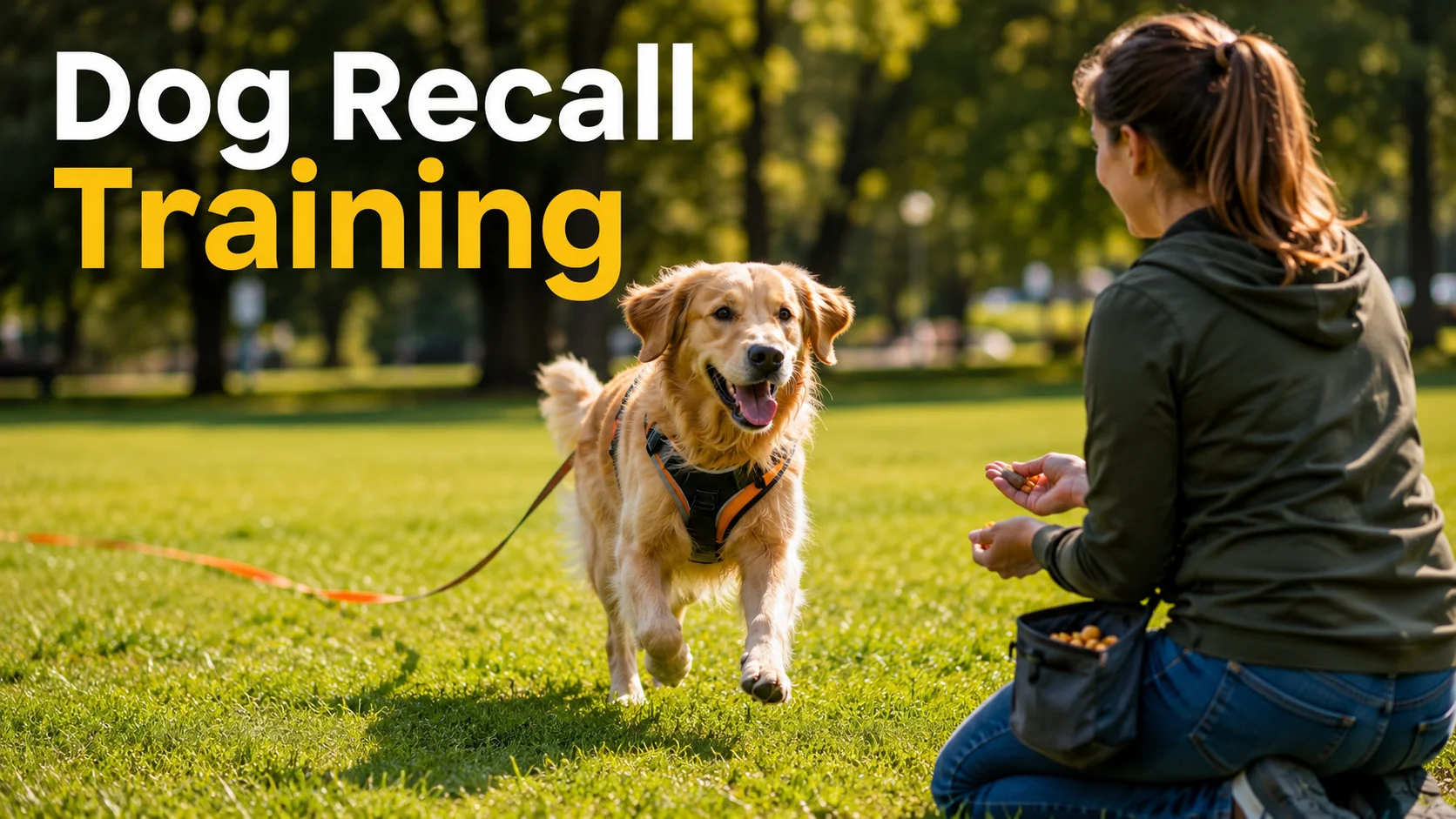
Dog recall training teaches your dog to return to you immediately when called, even when exciting distractions are nearby. The safest and most effective approach is to use positive reinforcement, short training sessions, and gradual practice in increasingly challenging environments. Begin indoors, progress to a secure outdoor area with a long training line, and reward every successful recall to build a dependable habit.
Introduction
Few commands are more valuable than a reliable recall. Whether your dog accidentally slips through an open gate, spots a squirrel during a walk, or gets distracted at the park, being able to call them back quickly can prevent dangerous situations and give you greater peace of mind.
Dog recall training isn’t about controlling your dog’s every movement. Instead, it’s about building trust and teaching your dog that returning to you is always rewarding. A strong recall allows your dog to enjoy more freedom while helping you keep them safe in everyday situations.
Many owners become frustrated because their dog responds perfectly inside the house but seems to ignore every command once they step outside. This is completely normal. Outdoor environments are full of interesting smells, sounds, people, and animals that naturally compete for your dog’s attention. The solution isn’t punishment or repeating the command louder. It’s teaching your dog, step by step, that coming back to you is always the best choice.
Whether you’re training a young puppy, an adult rescue, or simply improving your dog’s reliability, this guide will walk you through the entire process using safe, reward-based methods that build lasting results.
What Is Dog Recall Training?
Dog recall training is the process of teaching your dog to return to you immediately after hearing a specific cue, such as “Come,” “Here,” or a whistle signal. A successful recall means your dog willingly leaves whatever they’re doing and comes directly back to you.
Unlike commands such as “Sit” or “Stay,” recall asks your dog to turn away from something that may be far more exciting than you. That could be another dog, an interesting scent, a squirrel, or a group of people. For this reason, recall is often considered one of the most challenging obedience skills to teach.
The good news is that almost every healthy dog can learn a dependable recall with patience, consistency, and positive reinforcement.
What Is Recall in Dog Training?
“Recall” simply means asking your dog to return to your side whenever you give your chosen cue.
Common recall cues include:
- Come
- Here
- Front
- Your dog’s name followed by “Come”
- A whistle signal
Choose one cue and use it consistently. Switching between different words like “Come,” “Here,” “Get over here,” or “Come on” can confuse your dog and slow their progress.
Why Dog Recall Training Is So Important
A dependable recall is much more than an obedience exercise. It’s one of the most important safety skills your dog can learn.
Imagine these situations:
- Your dog slips out of the front door.
- A leash accidentally breaks during a walk.
- Your dog notices a rabbit across a busy road.
- Someone leaves the backyard gate open.
- Another off-leash dog runs toward your pet.
In every one of these situations, a reliable recall can help prevent injury, reduce stress, and allow you to regain control quickly.
Recall training also strengthens your relationship with your dog. Instead of responding because they’re afraid of punishment, your dog learns that returning to you always leads to praise, rewards, and positive experiences. This creates trust, confidence, and a stronger bond over time.
Recall vs. Loose Leash Walking
Many first-time dog owners assume recall and loose leash walking are the same skill, but they teach completely different behaviors.
Loose leash walking teaches your dog to walk calmly beside you without pulling on the leash.
Recall teaches your dog to return to you after moving away.
For example, a dog may walk politely on a leash but refuse to come when called in an open field. Likewise, a dog with an excellent recall may still need additional training to stop pulling during walks.
Teaching both skills separately creates a well-rounded, well-mannered companion.
Benefits of a Reliable Recall
Investing time in dog recall training provides benefits that last throughout your dog’s life.
Some of the biggest advantages include the following:
- Improves your dog’s safety around roads and traffic.
- Reduces the risk of your dog becoming lost.
- Helps prevent chasing wildlife or other animals.
- Makes outdoor adventures more enjoyable.
- Builds stronger focus and impulse control.
- Strengthens communication between you and your dog.
- Increases confidence in new environments.
- Supports future obedience training.
A reliable recall also gives your dog more opportunities to safely enjoy hiking, camping, beach trips, and secure off-leash areas where permitted.
Equipment You’ll Need
You don’t need expensive equipment to teach great recall. Most owners already have everything required to get started.
High-Value Rewards
Your reward should be more exciting than the environment around your dog.
Great choices include:
- Cooked chicken
- Freeze-dried liver treats
- Cheese cubes
- Soft training treats
- Small pieces of turkey
- A favorite toy for play-motivated dogs
Reserve these rewards for recall whenever possible. This helps make returning to you especially rewarding.
Comfortable Harness
A properly fitted harness gives you better control while reducing pressure on your dog’s neck.
Look for a harness that:
- Fits securely
- Doesn’t restrict shoulder movement
- Allows comfortable walking and running
Long Training Line
A long training line is one of the best investments for recall training.
Popular lengths include:
- 15 feet
- 20 feet
- 30 feet
- 50 feet for advanced practice
Unlike retractable leashes, a long line allows your dog to explore while still keeping them safely under control.
Standard Leash
Your regular walking leash is useful for practicing recalls during neighborhood walks before progressing to larger training areas.
Dog Whistle (Optional)
Some trainers prefer using a whistle instead of a verbal recall cue because it produces the same sound every time.
Benefits include:
- Consistent tone
- Easy to hear from a distance
- Useful during windy weather
- Less influenced by emotion
If you choose a whistle, always use the same pattern and reward every successful recall.
Preparing Your Dog for Recall Training
A successful recall begins long before your first training session.
Preparing the environment correctly helps your dog succeed and prevents frustration for both of you.
Start in a Low-Distraction Area
Choose a place where your dog can easily focus on you.
Good locations include the following:
- Your living room
- A hallway
- A fenced backyard
- A quiet enclosed field
- An empty tennis court
Avoid dog parks or busy public spaces until your dog has mastered the basics.
Keep Sessions Short
Dogs learn best through short, enjoyable training sessions.
Aim for:
- 5 to 10 minutes
- Two to four sessions each day
- Finish while your dog is still engaged
Frequent short sessions produce better results than one long training session.
Use a Cheerful Recall Cue
Your tone of voice has a big influence on how your dog responds.
Call your dog using a happy, encouraging voice rather than sounding frustrated or demanding. Your recall cue should always predict something positive.
Never Punish Your Dog for Coming Back
This is one of the biggest mistakes dog owners make.
Even if your dog ignores you for several minutes before returning, avoid scolding or punishing them.
If your dog associates returning with negative consequences, they’ll become less likely to come the next time.
Instead, reward every successful recall generously and make future training easier by reducing distractions if needed.
Be Patient and Set Realistic Expectations
Reliable recall doesn’t happen overnight.
A puppy learning indoors won’t respond perfectly around squirrels after a few days of practice, and an adult rescue may need extra time to build confidence.
Progress comes through hundreds of successful repetitions across different environments. Every positive experience strengthens your dog’s understanding that coming when called is always worth it.
By building this strong foundation first, you’ll be ready to move into practical recall exercises, outdoor training, and distraction-proofing techniques in the next section.
Step-by-Step Dog Recall Training
Teaching your dog to come when called isn’t something that happens in a single afternoon. A reliable recall is built through small, consistent successes that gradually become a habit. Every successful repetition strengthens your dog’s understanding that returning to you is always rewarding.
The key is to make training easy at first. Start in a quiet environment with very few distractions, then slowly increase the challenge as your dog’s confidence grows. Rushing the process often leads to frustration and unreliable results.
Remember, the goal isn’t just getting your dog to come once. It’s creating a response you can trust throughout your dog’s life.
Step 1: Choose a Recall Cue
Before you begin training, decide on one recall command and use it every time.
Popular recall cues include:
- Come
- Here
- Front
- Your dog’s name followed by “Come”
- A whistle signal
Avoid changing between different words like “Come,” “Here,” “Come on,” or “Get over here.” Using one consistent cue helps your dog understand exactly what you’re asking.
Your recall cue should always sound cheerful and inviting.
Step 2: Start Training Indoors
Your home is the perfect place to introduce recall because there are very few distractions.
Stand only a few feet away from your dog.
Call your recall cue once using a happy voice.
As soon as your dog walks toward you:
- Praise enthusiastically.
- Reward immediately with a high-value treat.
- Gently pet your dog if they enjoy affection.
The reward should be given within one or two seconds after your dog reaches you. Quick rewards help your dog connect the behavior with the outcome.
Practice several short recalls around different rooms of the house until your dog begins responding immediately.
Step 3: Increase the Distance
Once your dog responds consistently from a few feet away, gradually increase the distance.
Practice recalls:
- Across the living room
- Down a hallway
- Around furniture
- From another room
Each successful repetition helps your dog understand that the recall cue means the same thing no matter where you are.
If your dog struggles, simply shorten the distance and practice again before making it harder.
Step 4: Make Recall a Fun Game
Dogs learn best when training feels like play.
One simple exercise is the “Recall Ping-Pong Game.”
Ask two or three family members to stand several feet apart.
Each person calls the dog one at a time.
Whenever the dog arrives:
- Praise warmly.
- Give a treat.
- Allow the next person to call.
Dogs usually enjoy this game because they earn multiple rewards while practicing the same skill.
It also teaches your dog that running toward people is fun and rewarding.
Step 5: Introduce a Long Training Line
One of the safest ways to practice recall outdoors is by using a long training line.
Unlike a retractable leash, a long line allows your dog to explore naturally while preventing them from running away.
A 20- to 30-foot-long line works well for most beginners.
Allow your dog to walk around and sniff the environment.
Wait until they’re mildly distracted.
Call your recall cue once.
If your dog immediately turns and comes toward you:
- Celebrate with enthusiastic praise.
- Reward generously.
- Allow your dog to continue exploring afterward.
Letting your dog return to play teaches them that coming back doesn’t always end the fun.
Step 6: Build Distance Slowly
One of the biggest mistakes owners make is increasing distance too quickly.
Instead, increase distance gradually.
For example:
Week 1
Practice recalls from:
- 5 feet
- 8 feet
- 10 feet
Week 2
Increase to:
- 15 feet
- 20 feet
Week 3
Practice from:
- 25 feet
- 30 feet
Week 4
Begin practicing across larger open areas while continuing to use your long line.
Only increase distance after your dog is responding consistently at the current level.
Step 7: Add Distractions Gradually
A reliable recall isn’t tested in your living room.
It’s tested when something exciting captures your dog’s attention.
However, distractions should be introduced one at a time.
Mild Distractions
Begin with simple distractions such as:
- Leaves blowing
- Family members walking nearby
- Toys placed on the ground
- Gentle outdoor sounds
Reward every successful recall.
Moderate Distractions
As your dog improves, practice around the following:
- People walking
- Children playing nearby
- Calm dogs at a distance
- Cyclists
- New parks
Continue rewarding generously whenever your dog chooses to return to you instead of investigating the distraction.
Advanced Distractions
Eventually you can practice around the following:
- Busy walking trails
- Wildlife scents
- Groups of people
- Joggers
- Dogs playing at a distance
If your dog’s recall becomes unreliable, don’t become frustrated.
Simply move farther away from the distraction and continue practicing at an easier level.
Progress isn’t always perfectly linear.
Step 8: Teach an Emergency Recall
Many professional trainers recommend teaching a special emergency recall.
Unlike your everyday recall cue, this command is reserved only for situations where immediate response is essential.
Examples include:
- Your dog is heading toward a road.
- Your dog chasing wildlife.
- A loose dog approaching.
- Your dog escaping through an open gate.
Choose a unique cue such as the following:
- “Emergency!”
- “Now!”
- A special whistle pattern
Whenever your dog responds correctly, reward them with something extraordinary.
Examples include:
- Several pieces of cooked chicken
- A favorite toy
- A short game of tug
- Multiple treats given one after another
Because this cue is rarely used, it often remains highly reliable.
Sample Four-Week Dog Recall Training Plan
Following a simple weekly plan helps many owners stay consistent.
Week 1 – Build the Foundation
Focus on:
- Name recognition
- Indoor recalls
- Short distances
Practice:
- Three sessions each day
- Five to ten minutes per session
Goal:
Your dog happily runs toward you inside the house.
Week 2 – Backyard Practice
Focus on:
- Long line introduction
- Slightly longer recalls
- Mild distractions
Goal:
Reliable recall inside your fenced yard.
Week 3 – Quiet Outdoor Locations
Practice in:
- Quiet parks
- Open fields
- Large fenced areas
Increase both distance and distractions gradually.
Week 4 – Everyday Practice
Begin incorporating recall into daily life.
Practice during:
- Walks
- Backyard play
- Hiking trips
- Park visits
- Games of fetch
Your goal isn’t perfection.
Instead, focus on building consistent success in many different environments.
Daily Recall Training Routine
A simple routine can dramatically improve your dog’s progress.
Warm-Up (2 Minutes)
Start with commands your dog already knows.
Examples include:
- Sit
- Down
- Touch
- Eye contact
Reward generously.
This helps your dog focus before recall practice begins.
Recall Practice (5 Minutes)
Allow your dog to explore using a long line.
Call your recall cue once.
When your dog returns:
- Praise enthusiastically.
- Reward immediately.
- Release them to continue exploring.
Repeating this sequence teaches your dog that returning doesn’t always end the adventure.
Distance Practice (3 Minutes)
Gradually increase the distance between you and your dog.
Reward every successful recall.
If your dog struggles, reduce the distance before trying again.
Cool Down (2 Minutes)
Finish the session with something enjoyable such as:
- Fetch
- Tug
- Gentle play
- Relaxed walking
Ending every session on a positive note keeps your dog excited for future training.
Indoor and Outdoor Recall Tips
As your dog’s skills improve, practice recall naturally throughout the day instead of limiting it to formal training sessions.
Great opportunities include the following:
- Before serving meals
- During backyard play
- Before opening the back door
- During neighborhood walks
- Before throwing a toy
- At secure parks
- While hiking with a long training line
The more successful recalls your dog experiences in everyday life, the stronger and more dependable the behavior becomes.
Keep sessions enjoyable, reward generously, and remember that consistency is far more important than speed. Every successful repetition brings your dog one step closer to developing a reliable recall that you can trust in real-world situations.
Certainly. Here’s a completely rewritten Part 3 with a more natural flow, stronger SEO, better readability, and a style similar to high-quality pet websites. It avoids repetitive wording, removes unnecessary sections, and is ready for WordPress.
Solving Common Dog Recall Training Problems
Even dogs that perform well during practice can struggle in real-life situations. New environments, exciting scents, wildlife, or other dogs can easily distract them. The key is not to become frustrated. Instead, identify why your dog isn’t responding and adjust your training so they can succeed.
Recall isn’t about demanding perfect obedience. It’s about building a habit where your dog chooses to return because they’ve learned it’s always rewarding.
Why Does My Dog Ignore the Recall Cue?
If your dog comes when called at home but ignores you outdoors, distractions are usually the reason. Parks, trails, and neighborhoods offer far more interesting things than your living room.
Instead of repeating your cue, lower the difficulty of the exercise.
You can improve your dog’s response by:
- Moving to a quieter location.
- Practicing at a shorter distance.
- Using higher-value treats such as chicken or cheese.
- Keeping your dog on a long training line.
- Ending the session before your dog becomes tired or distracted.
If your dog fails several times in a row, the exercise is probably too difficult. Go back one step and rebuild your success before increasing the challenge again.
My Dog Comes Back Slowly
A slow recall usually means your dog doesn’t think returning is especially exciting.
Ask yourself what happens after your dog reaches you. If every recall ends the walk or playtime, your dog has little motivation to hurry.
Make returning worthwhile by:
- Rewarding immediately.
- Using enthusiastic praise.
- Occasionally offering several treats instead of one.
- Playing a short game after your dog returns.
- Releasing your dog to continue exploring once in a while.
Dogs that expect something enjoyable are much more likely to return quickly.
My Dog Only Comes When I Have Treats
Many owners worry that their dog is “treat-dependent.” In reality, food is simply helping build the behavior.
Once your dog responds reliably, you can begin reducing food rewards without removing them completely.
Try this approach:
- Keep treats hidden instead of holding them in your hand.
- Reward every successful recall with praise.
- Give food rewards randomly.
- Sometimes reward with a favorite toy or a short play session instead.
This keeps your dog guessing and maintains enthusiasm without expecting a treat every single time.
My Dog Runs Away When I Call
Dogs are excellent at recognizing patterns.
If every recall means the fun is over, they quickly learn to avoid returning.
For example, don’t only call your dog when it’s time to
- Leave the park.
- End a walk.
- Go inside.
- Take a bath.
- Trim nails.
Instead, regularly call your dog, reward them generously, and then allow them to continue playing. This simple habit teaches your dog that coming back doesn’t always end the adventure.
Common Recall Training Mistakes
Many recall problems aren’t caused by stubborn dogs. They’re caused by small training mistakes that accidentally weaken the behavior.
Repeating the Cue
Calling “Come, come, come!” teaches your dog that the first cue isn’t important.
Give the cue once, wait a moment, and help your dog succeed if necessary. Over time, your dog will learn that one cue always deserves a response.
Progressing Too Quickly
Your dog may respond perfectly indoors but struggle in a busy park.
Rather than assuming they forgot their training, remember that distractions make every exercise more difficult.
Increase the challenge gradually by introducing only one new distraction at a time.
Punishing Your Dog After They Return
Never scold your dog for eventually coming back.
Even if your dog ignored you for several minutes, punishment only teaches them that returning leads to unpleasant experiences.
Always reward the return, then make your next training session easier.
Making Training Sessions Too Long
Dogs learn best through short, enjoyable sessions.
Five to ten minutes of focused practice is usually far more productive than thirty minutes of repetition.
Finish while your dog is still eager to work.
Sample Daily Recall Routine
A simple routine practiced every day can produce excellent results.
Warm-up – 2 minutes
Practice easy behaviors your dog already knows, such as sit, down, or touch. This helps your dog focus before recall work begins.
Recall practice – 5 minutes
Allow your dog to explore on a long line. Call your recall cue once, reward generously when they return, and occasionally release them to explore again.
Distance practice – 3 minutes
Gradually increase the distance between you and your dog while continuing to reward every successful recall.
Finish with play—2 minutes
End the session with fetch, tug, or another activity your dog enjoys. Ending on a positive note makes your dog look forward to future training.
Signs Your Dog Is Improving
Reliable recall develops gradually, so don’t judge progress by a single training session.
You’re moving in the right direction if your dog:
- Turns toward you immediately after hearing the cue.
- Returns faster than before.
- Responds in different locations.
- Ignores mild distractions.
- Maintains focus after reaching you.
- Needs fewer repeated reminders.
Small improvements eventually become dependable habits.
When Should You Get Professional Help?
Some recall challenges require additional guidance.
Consider working with a qualified, reward-based trainer if:
- Your dog repeatedly runs away.
- Recall has become a serious safety concern.
- Your dog chases wildlife, livestock, or moving vehicles.
- Progress has stopped despite consistent practice.
- Your dog becomes fearful or anxious during training.
If your dog’s behavior changes suddenly or they stop responding to commands they previously knew, schedule a veterinary examination. Pain, illness, hearing loss, or age-related changes can affect your dog’s ability to respond.
Safety Tips for Reliable Recall
No dog has a perfect recall in every situation.
Until your dog consistently responds in different environments, continue using a long training line or practice inside securely fenced areas.
Keep these safety tips in mind:
- Never practice off-leash near busy roads.
- Avoid unfenced areas until recall is dependable.
- Check local leash laws before allowing off-leash exercise.
- Carry high-value rewards during outdoor training.
- Continue practicing recall throughout your dog’s life.
Regular practice keeps the behavior strong and reliable.
Conclusion
Dog recall training is one of the most valuable skills you can teach your dog because it improves both safety and communication. A dependable recall doesn’t happen overnight, but every successful training session brings your dog one step closer to responding confidently in real-life situations.
Focus on short, enjoyable sessions, reward every success, and gradually increase distractions as your dog improves. Stay patient, remain consistent, and avoid rushing the process. Over time, your dog will learn that coming back to you is always the best choice, whether you’re at home, in the park, or exploring the outdoors together.
FAQs
Q1. What is dog recall training?
Dog recall training teaches your dog to return immediately when you give a cue such as “Come” or “Here.” It helps improve safety and allows your dog to enjoy greater freedom while remaining under control.
Q2. How long does recall training take?
Most dogs learn the basics within a few weeks, but building a reliable recall around distractions often takes several months of regular practice.
Q3. Can older dogs learn recall?
Yes. Adult and senior dogs can learn recall successfully with patience, consistency, and reward-based training.
Q4. Should I use a dog whistle for recall?
A dog whistle can be helpful because it produces a consistent sound that’s easy for dogs to recognize over long distances. Many owners find it useful alongside verbal recall cues.
Q5. Why does my dog ignore me outside?
Outdoor environments contain far more distractions than your home. Practice in quieter locations first and gradually increase the level of difficulty as your dog improves.
Q6. When can I trust my dog off-leash?
Only consider off-leash freedom after your dog has demonstrated reliable recall in multiple locations and under different levels of distraction. Until then, use a long training line or stay within securely fenced areas.
Q7. What’s the difference between recall and loose leash walking?
Recall teaches your dog to return when called, while loose leash walking teaches your dog to walk calmly beside you without pulling. Both are essential skills but should be trained separately.
Q8. What is the biggest mistake in recall training?
One of the most common mistakes is only calling your dog when the fun is about to end. Instead, reward your dog for returning and sometimes allow them to continue playing so the recall cue always has a positive meaning.