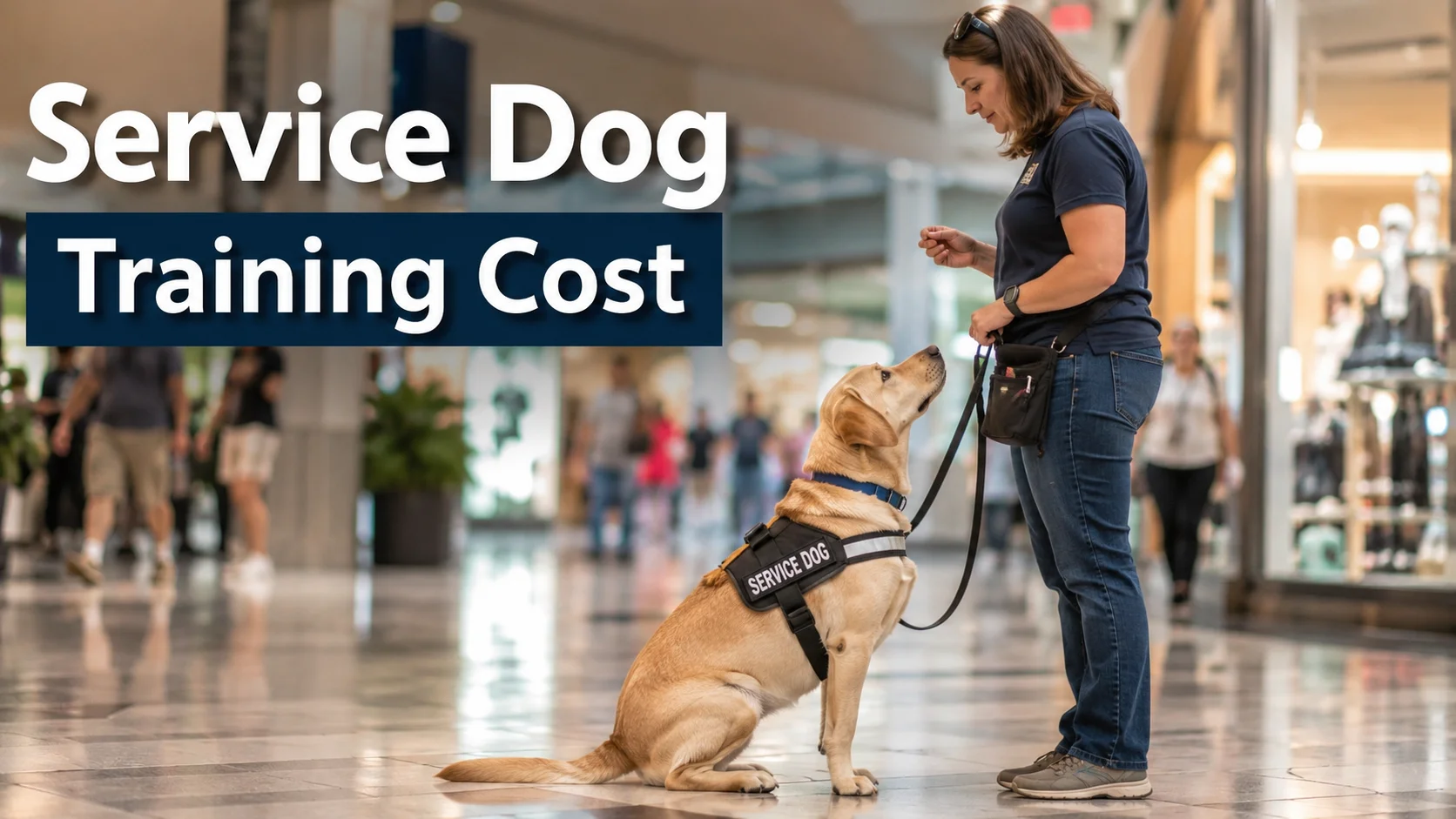
Quick Answer
The average service dog training cost ranges from several thousand dollars to more than $30,000 depending on whether you train your own dog, work with a professional trainer, or obtain a fully trained service dog. Costs vary based on task training, public access work, the dog’s temperament, training duration, and the type of disability-related assistance required.
Introduction
Understanding service dog training costs can feel overwhelming, especially when you first begin researching service dogs. Prices online vary widely, and many owners are unsure what services are included, what training is legally required, and whether owner training is a realistic option.
A service dog is not simply a well-behaved pet. These dogs perform specific tasks that directly help a person with a disability. Because of this, training involves much more than basic obedience. Dogs must learn advanced skills, reliable behavior in public places, distraction control, and disability-related task work.
Whether you are considering a psychiatric service dog, mobility assistance dog, medical alert dog, or another type of working service dog, understanding the costs involved helps you make informed decisions. This guide explains where expenses come from, what affects pricing, realistic timelines, legal considerations, and how to avoid common mistakes during the training process.
What Does Service Dog Training Cost Mean?
When people ask about service dog training costs, they are usually referring to the total expense required to transform a suitable dog into a reliable working service dog.
Training costs often include the following:
- Professional evaluations
- Temperament testing
- Basic obedience training
- Public access training
- Task-specific training
- Private coaching sessions
- Group classes
- Equipment and supplies
- Ongoing practice and maintenance
Unlike standard pet training, service dog preparation requires a much higher level of reliability. A service dog must remain calm around crowds, shopping carts, children, food, other dogs, loud noises, and unexpected distractions while continuing to perform trained tasks safely.
Service Dog vs Therapy Dog vs Emotional Support Dog
Many people confuse these categories. Understanding the difference is important before discussing costs.
Service Dog
A service dog is individually trained to perform specific tasks for a person with a disability.
Examples include:
- Guiding a visually impaired handler
- Alerting to medical conditions
- Retrieving dropped items
- Interrupting psychiatric episodes
- Providing mobility assistance
Service dogs generally have public access rights under applicable laws.
Therapy Dog
A therapy dog provides comfort to other people in settings such as:
- Hospitals
- Schools
- Nursing homes
- Counseling centers
Therapy dogs do not have the same public access rights as service dogs.
Emotional Support Dog
An emotional support dog provides companionship and emotional comfort.
An emotional support dog does not require task training and is not considered a service dog under most public access laws.
This distinction matters because service dog training is significantly more extensive and therefore much more expensive.
Eligibility and Temperament: Can Any Dog Become a Service Dog?
One of the biggest misconceptions is that any dog can become a service dog.
In reality, temperament is one of the most important factors affecting success.
Ideal Service Dog Traits
Successful candidates often demonstrate:
- Confidence
- Low fear levels
- Stable temperament
- Strong focus on handlers
- Good health
- Trainability
- Calm behavior around distractions
- Low reactivity
Traits That May Disqualify a Dog
Some dogs struggle with service work due to:
- Aggression
- Severe anxiety
- Extreme fearfulness
- Noise sensitivity
- Resource guarding
- Poor impulse control
- Excessive prey drive
A professional temperament assessment can help determine whether a dog is a suitable candidate before significant money is invested.
Factors That Affect Service Dog Training Cost
No two service dog programs cost exactly the same.
Several factors influence pricing.
1. Type of Service Dog
Different disabilities require different tasks.
Examples include:
- Psychiatric service dogs
- Mobility assistance dogs
- Medical alert dogs
- Hearing dogs
- Guide dogs
More complex task training often increases overall expenses.
2. Professional Training vs Owner Training
Many handlers choose professional programs.
Other owners train with guidance from experienced trainers.
Professional training generally costs more but may reduce mistakes and improve consistency.
3. Dog’s Starting Age
Puppies require foundational training before advanced service work begins.
Adult dogs with strong obedience skills may progress faster if they have the right temperament.
4. Geographic Location
The cost of service dog training near me can vary significantly depending on:
- Local trainer rates
- Urban versus rural areas
- Regional demand
- Availability of specialized trainers
Major metropolitan areas often charge higher fees.
5. Public Access Training Requirements
Public access skills require extensive practice in real-world environments.
Dogs must learn appropriate behavior in:
- Restaurants
- Shopping centers
- Airports
- Hotels
- Public transportation
- Medical facilities
This advanced training adds substantial time and expense.
Cost of Training a Service Dog Through Professional Programs
Many professional service dog programs charge between several thousand and tens of thousands of dollars depending on the level of training provided.
Typical expenses may include:
- Initial evaluations
- Obedience foundations
- Task development
- Public access preparation
- Handler instruction
- Follow-up support
Some organizations raise funds through donations and grants, while others charge the full cost directly to clients.
When comparing programs, always ask:
- What training is included?
- How many private sessions are provided?
- Is public access training included?
- Are follow-up lessons available?
- What happens if the dog washes out?
A reputable program should clearly explain all fees and expectations.
How Much Does a Trained Service Dog Cost?
Some people purchase a fully trained service dog from an established organization.
These dogs often represent years of work before placement.
Costs may exceed $20,000 to $50,000 or more depending on the following:
- Breeding programs
- Veterinary care
- Puppy raising
- Professional trainers
- Advanced task training
- Placement support
In some cases, nonprofit organizations help offset part of these expenses through fundraising or sponsorship programs.
Psychiatric Service Dog Training Cost
Psychiatric service dogs assist individuals with qualifying mental health disabilities by performing specific trained tasks.
Examples include:
- Interrupting panic attacks
- Guiding handlers away from overwhelming situations
- Providing grounding behaviors
- Medication reminders
- Creating personal space barriers
Psychiatric service dog training costs vary depending on task complexity and training approach.
Because psychiatric service dogs require both public access reliability and task performance, training expenses can be comparable to other service dog specialties.
Service Dog Training Cost for PTSD
PTSD service dogs are among the most commonly requested psychiatric service dogs.
Task training may include:
- Nightmare interruption
- Room checks
- Anxiety interruption
- Crowd buffering
- Grounding during dissociative episodes
PTSD service dog training typically requires extensive real-world practice to ensure reliable responses in challenging environments.
This additional training time often contributes to overall costs.
Step-by-Step Training Path for a Service Dog
Many owners researching how much it costs to train a service dog also want to understand the actual training process.
Service dog training typically follows several stages. Skipping steps often creates problems later.
Step 1: Temperament Evaluation
Before training begins, the dog should be assessed for:
- Confidence
- Sociability
- Environmental stability
- Ability to recover from stress
- Food and toy motivation
- Trainability
This step helps determine whether the dog is a realistic candidate for service work.
Step 2: Basic Obedience Foundation
Every future service dog needs excellent obedience skills.
Core commands include:
- Sit
- Down
- Stay
- Come
- Leave it
- Heel
- Place
- Wait
These behaviors must become reliable around distractions before advanced work begins.
Step 3: Socialization and Environmental Exposure
Dogs need positive exposure to:
- Busy streets
- Shopping centers
- Elevators
- Automatic doors
- Public transportation
- Crowds
- Different surfaces
- Medical facilities
The goal is calm confidence rather than excitement or fear.
Step 4: Public Access Training
Public access work teaches dogs to behave appropriately in places where pets are normally not allowed.
Skills often include:
- Settling quietly under tables
- Ignoring food on the ground
- Remaining focused around other dogs
- Walking politely through crowds
- Maintaining calm behavior in waiting rooms
This phase often takes many months of consistent practice.
Step 5: Task Training
Task training is what separates a service dog from a well-trained pet.
Tasks must directly mitigate the handler’s disability.
Examples include:
- Medical alerts
- Retrieval tasks
- Mobility support
- Deep pressure therapy
- Anxiety interruption
- Guide work
- Hearing alerts
Task reliability requires extensive repetition in different environments.
Step 6: Ongoing Maintenance Training
Even fully trained service dogs need regular practice.
Without reinforcement, skills can weaken over time.
Most successful handlers continue training throughout the dog’s working life.
Public Access Training: Why It Increases Costs
One major factor affecting the cost of service dog training is public access preparation.
Many dogs can perform tasks at home.
Far fewer can perform those same tasks reliably in the following:
- Airports
- Grocery stores
- Hotels
- Medical offices
- Sporting events
- Shopping malls
Public access training requires:
- Controlled exposure
- Trainer supervision
- Repetition
- Problem-solving
- Real-world practice sessions
The time investment alone often adds significantly to training expenses.
Public Access Skills Every Service Dog Should Learn
Reliable public access behavior usually includes the following:
- Loose-leash walking
- Calm behavior around strangers
- Ignoring distractions
- Quiet settling
- Controlled entrances and exits
- Reliable recall when appropriate
- No excessive barking
- No jumping on people
- No aggression toward animals or humans
Many organizations use public access evaluations to measure readiness for working environments.
How Long Does Service Dog Training Take?
Training timelines vary considerably.
Several factors affect progress:
- Dog age
- Breed
- Temperament
- Previous training
- Task complexity
- Handler consistency
Typical Timeline
Many service dogs require the following:
- 6 to 12 months for strong obedience foundations
- 12 to 24 months for advanced service work
- Ongoing maintenance training throughout their careers
Some dogs learn faster, while others require additional time.
Owners should be cautious of programs promising extremely fast results.
Reliable service work takes patience and repetition.
Typical Expenses Beyond Training Fees
When calculating service dog training costs, many owners forget additional expenses.
Common costs may include:
Veterinary Care
- Wellness exams
- Vaccinations
- Preventive medications
- Emergency care
Equipment
- Service dog vest
- Harnesses
- Leashes
- Treat pouches
- Training rewards
- Identification gear
Travel Costs
Some handlers travel to specialized trainers or programs.
Expenses may include:
- Transportation
- Lodging
- Meals
- Follow-up visits
Continuing Education
Many teams continue taking lessons after placement.
This helps maintain reliability and address new challenges.
Owner Training vs Professional Training
A common question is whether owner-training reduces the cost to train a service dog.
The answer is often yes, but there are trade-offs.
Advantages of Owner Training
- Lower overall costs
- Strong handler-dog bond
- Flexible scheduling
- Personalized training pace
Challenges of Owner Training
- Steeper learning curve
- Greater risk of mistakes
- More time commitment
- Difficulty troubleshooting behavior issues
Many successful handlers combine owner-training with professional coaching.
This hybrid approach often provides a balance between affordability and expert guidance.
Common Breeds Used for Service Work
Although many breeds can succeed, some are more commonly chosen because of temperament and trainability.
Popular examples include:
- Labrador Retriever
- Golden Retriever
- Standard Poodle
- Labrador-Poodle crosses in some programs
These breeds often demonstrate:
- Trainability
- Social stability
- Adaptability
- Strong handler focus
However, breed alone does not guarantee success.
Individual temperament always matters more than breed reputation.
Sample Weekly Service Dog Training Routine
A structured routine helps maintain progress.
Monday
- Obedience review
- Loose-leash walking
- Recall practice
Tuesday
- Public access outing
- Focus exercises
- Settle training
Wednesday
- Task training session
- Impulse control games
Thursday
- Exposure to new environments
- Public behavior practice
Friday
- Review previous skills
- Reward-based reinforcement
Saturday
- Longer public outing
- Task proofing around distractions
Sunday
- Light review
- Mental enrichment activities
- Rest and recovery
Short daily sessions are usually more effective than occasional marathon training days.
Requirements for Therapy Dogs in Comparison to Service Dogs
Therapy dogs and service dogs have very different purposes.
Therapy dog programs generally focus on:
- Friendly temperament
- Good manners
- Comfort around strangers
- Reliable obedience
Service dogs require:
- Disability-related task training
- Advanced public access skills
- Higher reliability standards
- Ongoing working responsibilities
Because of these differences, service dog training costs are typically much higher.
Emotional Support Dogs and Training Costs
An emotional support dog provides emotional comfort through companionship.
Unlike service dogs, emotional support dogs do not require the following:
- Public access training
- Disability-specific task work
- Advanced service skills
As a result, emotional support dog training costs are usually much lower than service dog training costs.
Owners often focus on:
- Basic obedience
- House manners
- Socialization
- Confidence building
Understanding this distinction prevents confusion when comparing training prices.
How to Choose a Service Dog Trainer
Finding the right trainer can save money and frustration.
Look for professionals who:
- Use reward-based methods
- Have experience with service dog development
- Explain training plans clearly
- Welcome questions
- Offer realistic expectations
- Provide ongoing support
Ask potential trainers:
- What disabilities have you trained service dogs for?
- What does your program include?
- How long does training typically take?
- How do you evaluate temperament?
- What happens if a dog is not suitable?
A trustworthy trainer will answer openly and avoid unrealistic promises.
Legal Basics Every Future Service Dog Handler Should Understand
Many people researching service dog training cost also encounter confusing information about certifications, registrations, and legal requirements.
The most important thing to understand is that service dog laws vary by country, state, province, and local jurisdiction.
In the United States
Generally, a service dog must be:
- Individually trained to perform tasks related to a person’s disability
- Under control in public
- House trained
- Able to behave appropriately in public settings
The key factor is the dog’s training and ability to perform disability-related tasks, not simply owning a vest, ID card, or online registration.
Other Countries
Rules can differ in:
- Canada
- United Kingdom
- Australia
- European countries
Always verify local regulations before traveling or relying on information found online.
Certification Myths and Misleading Claims
One area that causes significant confusion involves certification.
Many websites advertise instant certifications, registrations, or identification cards.
Owners should be cautious.
Important Reality
A certificate alone does not transform a pet into a legitimate service dog.
Training remains the most important requirement.
Legitimate service dog development involves:
- Obedience training
- Public access training
- Task training
- Ongoing maintenance
No online form can replace these requirements.
Red Flags to Watch For
Be careful of organizations that:
- Guarantee every dog will qualify
- Promise certification without training
- Offer instant service dog status
- Ignore temperament evaluations
- Claim public access rights are automatic after registration
Responsible trainers focus on skills and behavior, not shortcuts.
Common Mistakes That Increase Service Dog Training Cost
Many handlers unintentionally spend more money because of avoidable mistakes.
Choosing the Wrong Dog
A poor temperament match can result in:
- Slow progress
- Behavioral problems
- Additional trainer fees
- Complete training failure
Starting with a suitable candidate is often the most cost-effective decision.
Skipping Foundation Training
Owners sometimes rush into task training before mastering the following:
- Sit
- Stay
- Recall
- Loose-leash walking
- Impulse control
Weak foundations create problems later.
Inconsistent Practice
Service dogs learn through repetition.
Training only once or twice per week often slows progress.
Relying on Online Advice Alone
Videos and articles can be helpful, but they cannot replace hands-on coaching for complex service work.
Training Too Long in One Session
Long sessions often reduce focus and motivation.
Most dogs learn better through:
- Short sessions
- Frequent repetition
- Positive reinforcement
- Clear rewards
Signs Your Service Dog Is Making Progress
Owners often wonder whether training is moving in the right direction.
Positive signs include the following:
Better Focus
The dog pays attention despite distractions.
Improved Impulse Control
The dog waits calmly rather than reacting immediately.
Reliable Obedience
Commands work consistently in different locations.
Stronger Public Manners
The dog settles quietly in public environments.
Reliable Task Performance
Disability-related tasks become more consistent and dependable.
Faster Recovery From Distractions
The dog quickly returns attention to the handler after interruptions.
Progress is rarely perfectly linear. Temporary setbacks are normal during learning.
Challenges That May Slow Training
Even excellent candidates experience obstacles.
Common challenges include:
Adolescence
Many dogs go through a difficult adolescent phase between puppyhood and adulthood.
Temporary setbacks are common.
Fear Periods
Some dogs become temporarily sensitive to new experiences.
Careful exposure and positive reinforcement help maintain confidence.
Environmental Distractions
Busy locations can make concentration difficult.
Training should gradually increase in difficulty.
Health Issues
Physical discomfort can affect learning and behavior.
If performance changes suddenly, schedule a veterinary evaluation.
When to Seek Professional Help
Some situations benefit greatly from expert guidance.
Consider consulting a qualified trainer or behavior professional if:
- Training has stalled for months
- The dog shows fear in public
- Reactivity develops
- Aggression appears
- Task reliability is poor
- Public access behavior remains inconsistent
Veterinary Behaviorist Support
A veterinary behaviorist may be appropriate if behavior changes appear related to:
- Anxiety
- Medical issues
- Fear disorders
- Sudden personality changes
Early intervention often prevents larger problems later.
Safety Notes for Service Dog Training
Service dog training should always prioritize safety and welfare.
Use Reward-Based Training
Positive reinforcement encourages the following:
- Confidence
- Trust
- Motivation
- Reliable learning
Avoid Harsh Punishment
Fear-based methods can create:
- Stress
- Anxiety
- Reduced confidence
- Behavioral fallout
Respect the Dog’s Limits
Not every dog enjoys public access work.
Some dogs are happier as companion animals rather than working service dogs.
Monitor Health Carefully
Working dogs require regular veterinary care and ongoing wellness monitoring.
Protect Public Safety
A dog that shows aggression, severe fear, or unpredictable behavior should be professionally evaluated before continuing public access training.
Is Service Dog Training Worth the Cost?
For many individuals living with disabilities, a properly trained service dog can provide meaningful daily assistance and greater independence.
Potential benefits include the following:
- Increased confidence
- Improved mobility
- Better daily functioning
- Greater participation in public life
- Enhanced task support
However, service dogs are not a quick solution.
They require:
- Significant financial commitment
- Ongoing training
- Daily management
- Veterinary care
- Consistent practice
Understanding these responsibilities helps owners make informed decisions before investing in training.
Conclusion
Understanding service dog training costs involves much more than looking at a single price tag. Expenses vary based on the dog’s temperament, the complexity of task training, public access preparation, trainer experience, and whether the dog is owner-trained or professionally trained.
A successful service dog requires patience, consistency, and reward-based training. While costs can be substantial, careful planning, realistic expectations, and working with qualified professionals can help create a reliable working partner that provides meaningful assistance for years. Focus on proper training rather than shortcuts, certifications, or quick fixes, and always prioritize the dog’s welfare and long-term success.
FAQs
Q1. How much does service dog training cost on average?
Service dog training costs vary widely. Owner-training with professional support is generally less expensive than purchasing a fully trained service dog. Total expenses can range from several thousand dollars to tens of thousands depending on training needs.
Q2. How much does it cost to train a service dog for anxiety?
The cost depends on whether the dog is trained for psychiatric service work, the complexity of tasks required, trainer fees, and public access training needs. Psychiatric service dog programs often require extensive task and public behavior training.
Q3. How much does a trained service dog cost?
A fully trained service dog may cost $20,000 to $50,000 or more because the price often includes breeding, puppy raising, veterinary care, advanced training, and placement support.
Q4. Can I train my own service dog?
In many areas, owner-training is allowed if the dog meets applicable legal requirements and performs disability-related tasks reliably. Many handlers work with professional trainers during the process.
Q5. Does a service dog need certification?
Training and task performance are generally more important than online certifications. Laws vary by location, so always review local regulations.
Q6. What is public access training?
Public access training teaches a service dog to behave appropriately in places such as stores, restaurants, transportation systems, and medical facilities while remaining focused on the handler.
Q7. How long does service dog training take?
Many service dogs require 12 to 24 months of training before reaching reliable working standards, although timelines vary based on the dog and training goals.
Q8. What happens if a dog fails service dog training?
Some dogs are “washed out” because of temperament, health concerns, fearfulness, or other issues that make service work unsuitable. These dogs often become beloved family companions instead.