Quick Answer
An elopement-tracking dog trained for autism elopement is a dog trained to follow a specific person’s scent trail to help locate an autistic individual who has wandered away or become lost. These dogs require advanced scent-tracking skills, reliable obedience, impulse control, extensive socialization, and professional-level training. Because elopement can create serious safety concerns, training should focus on reliability, positive reinforcement, and safe handling practices.
Introduction
For many families affected by autism, wandering or elopement is one of the most concerning safety challenges they face. Some autistic children and adults may unexpectedly leave a safe environment, creating situations where caregivers must locate them quickly.
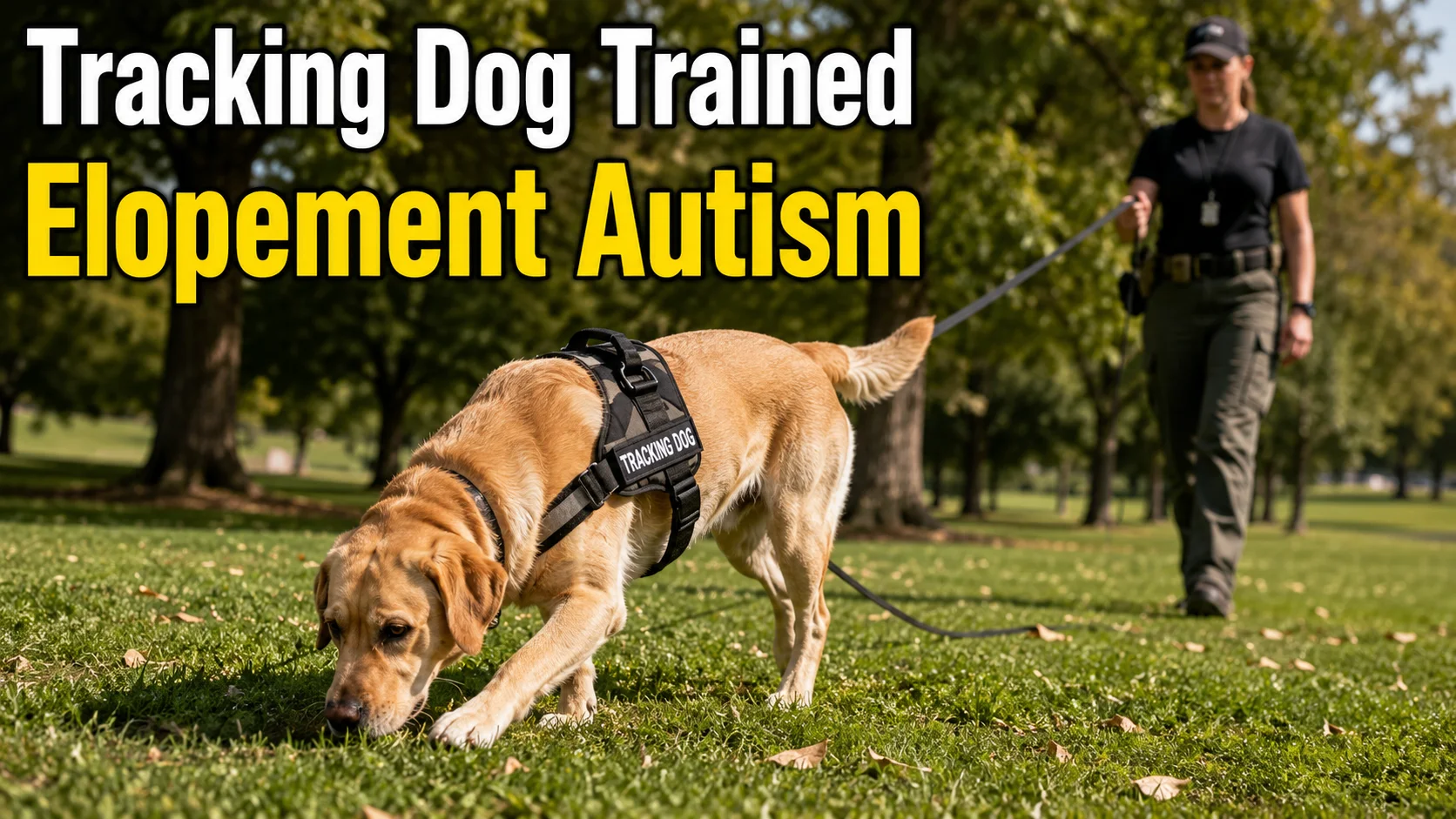
This is where a tracking dog trained in elopement autism can play an important role. Unlike a typical pet dog, a tracking dog learns to identify and follow an individual’s unique scent trail through various environments and distractions. These dogs combine scent work, obedience, focus, and advanced working-dog skills.
Training a dog for autism-related tracking is a specialized process. It requires a strong foundation in obedience, structured scent training, gradual exposure to real-world environments, and ongoing practice. Whether you are interested in assistance dog work, search and rescue-style tracking, or simply learning how these remarkable dogs are trained, understanding the process helps set realistic expectations.
The goal is not simply teaching a dog to follow a scent. The goal is developing a reliable canine partner capable of working safely under challenging conditions.
What “Tracking Dog Trained Elopement Autism” Means
A tracking dog trained for autism-related elopement is a dog that learns to locate a missing individual by following that person’s scent trail.
The dog is typically trained to do the following:
- Recognize a target scent
- Follow ground disturbance and scent trails
- Ignore distractions
- Work calmly around people and animals
- Continue tracking over different terrain
- Alert the handler when the person is located
These dogs are different from the following:
- Emotional support animals
- Therapy dogs
- Standard service dogs
- Basic companion dogs
Some autism assistance dogs may perform multiple tasks, including:
- Tracking a wandering child
- Providing calming pressure therapy
- Assisting with daily routines
- Supporting social interactions
- Improving safety during community outings
Important Distinction
Not every autism assistance dog is trained for tracking work.
Tracking is a highly specialized skill that requires advanced scent work, obedience training, and extensive practical experience.
Skills and Temperament Needed
Not every dog is naturally suited for tracking work. While most dogs possess an incredible sense of smell, successful tracking dogs need a combination of physical and behavioral traits.
Strong Scenting Ability
Tracking depends heavily on a dog’s natural olfactory capabilities.
Dogs must learn to:
- Identify target scents
- Maintain focus on scent trails
- Work through scent contamination
- Follow scent changes caused by weather conditions
Breeds commonly used in scent work include:
- Labrador Retrievers
- Golden Retrievers
- German Shepherds
- Bloodhounds
- Belgian Malinois
- Springer Spaniels
However, individual temperament often matters more than breed alone.
High Motivation
Successful tracking dogs genuinely enjoy working.
They are often highly motivated by:
- Food rewards
- Toys
- Praise
- Play
Motivation helps maintain focus during longer tracking sessions.
Emotional Stability
A tracking dog may encounter the following:
- Crowded environments
- Traffic sounds
- Wildlife
- New locations
- Unexpected distractions
Dogs that become overwhelmed easily may struggle to perform consistently in real-world situations.
Strong Handler Engagement
The dog should enjoy working closely with people and responding to direction.
Important qualities include:
- Reliable recall
- Attention to the handler
- Cooperative behavior
- Ability to recover from distractions
Physical Endurance
Tracking work often involves the following:
- Walking long distances
- Uneven terrain
- Different weather conditions
- Extended search periods
Good physical conditioning supports safe and effective performance.
Foundation Obedience
Before advanced tracking begins, every dog needs a solid obedience foundation.
Many tracking failures occur because handlers rush into scent work before basic skills are reliable.
Essential Commands
A future tracking dog should consistently respond to the following:
- Sit
- Down
- Stay
- Come
- Leave It
- Heel
- Place
- Wait
These commands create safety and control during tracking exercises.
Recall Training
Recall is especially important.
Even highly trained tracking dogs need a dependable response when tracking sessions end.
Practice recall in:
- Indoor environments
- Backyards
- Parks
- Low-distraction locations
- Moderate-distraction environments
Gradually increase difficulty and reward every successful response generously.
Leash Manners
Tracking dogs often work using long lines.
Good leash skills help prevent the following:
- Tangling
- Frustration
- Excessive pulling
- Safety risks
Practice calm walking before introducing specialized tracking equipment.
Impulse Control
Impulse control helps dogs ignore distractions and stay focused on their task.
Useful exercises include:
- Waiting at doorways
- Food bowl manners
- Stay exercises
- Controlled greetings
- Leave-it games
These skills improve tracking reliability later in training.
Equipment Needed
Training a tracking dog does not require expensive equipment in the beginning, but having the right tools can make training safer and more effective.
Tracking Harness
A dedicated tracking harness helps the dog understand when tracking work begins.
Benefits include:
- Clear work signal
- Comfortable movement
- Reduced pressure on the neck
- Better support during tracking
Many handlers reserve the harness exclusively for tracking sessions so the dog learns to associate it with work.
Long Line
Most trainers use a long line ranging from 15 to 40 feet.
A long line provides the following:
- Freedom to work
- Better scent-following opportunities
- Handler control
- Improved safety
Avoid retractable leashes for tracking work because they provide inconsistent tension and can create safety issues.
Scent Articles
The dog needs an item carrying the target person’s scent.
Common scent articles include:
- T-shirts
- Socks
- Hats
- Pillowcases
- Gloves
Handle scent articles carefully to avoid contamination from other people.
Reward System
Tracking dogs need rewards that are highly motivating.
Popular choices include:
- Soft training treats
- Chicken
- Cheese
- Tug toys
- Balls
- Play sessions
Choose rewards your dog finds exciting enough to maintain motivation during challenging exercises.
Training Journal
Many experienced handlers keep a tracking journal.
Record details such as:
- Trail length
- Weather conditions
- Track age
- Success rate
- Distractions encountered
- Areas needing improvement
Tracking performance often improves faster when progress is documented consistently.
Safety and Legal Notes
Training a tracking dog for autism-related elopement involves significant responsibility.
Safety First
A tracking dog should never replace the following:
- Caregiver supervision
- Safety planning
- Secure fencing
- Door alarms
- GPS tracking devices
- Community support systems
Dogs are valuable tools, but they should always be part of a broader safety strategy.
Work With Qualified Professionals
Because elopement can place a person in danger, professional guidance is strongly recommended.
Consider working with:
- Certified professional dog trainers
- Experienced scent work instructors
- Assistance dog organizations
- Search and rescue trainers
- Veterinary behaviorists when necessary
Veterinary Considerations
If a dog suddenly struggles with concentration, motivation, or tracking performance, consult a veterinarian.
Issues such as:
- Pain
- Illness
- Fatigue
- Sensory changes
can negatively affect a dog’s working ability.
Legal Considerations
Service dog and assistance dog laws vary depending on the following:
- Country
- State
- Province
- Municipality
Families should verify local regulations before assuming public access rights or service dog status.
Remember that therapy dogs, emotional support animals, and service dogs are not legally identical categories.
Humane Training Standards
Effective tracking training should focus on:
- Positive reinforcement
- Reward-based learning
- Consistency
- Clear communication
- Gradual progression
Avoid methods that rely on fear, pain, intimidation, or harsh corrections.
Dogs learn tracking most effectively when the process remains rewarding and enjoyable.
Step-by-Step Training Path
Training a tracking dog trained for autism elopement requires patience, consistency, and realistic expectations.
Most successful tracking dogs spend months developing reliable scent-tracking skills.
Step 1: Build Reward Value
Before tracking begins, the dog should understand that working with the handler is rewarding.
Spend several weeks strengthening:
- Food motivation
- Toy motivation
- Recall reliability
- Focus around distractions
- Engagement games
The dog should eagerly interact with the handler before moving into scent work.
Example
Call the dog, reward immediately with a high-value treat, then release for play. Repeat in multiple environments.
Step 2: Introduce Scent Association
The dog must learn that a specific scent belongs to a specific person.
Training process:
- Present a scent article.
- Allow the dog to investigate.
- Reward calm attention.
- Pair the scent with a tracking exercise.
The goal is for the dog to associate the scent article with a search task.
Step 3: Short Visual Trails
At this stage, the dog watches the target person walk away.
Training Process
- Target person walks 20 to 30 feet away.
- The dog observes the movement.
- Present the scent article.
- Give the tracking cue.
- Follow behind on a long line.
- Reward generously when the target is found.
Keep sessions short and successful.
Step 4: Increase Distance Gradually
As confidence grows, increase trail length.
Progress gradually:
- 30 feet
- 50 feet
- 100 feet
- 200 feet
- Longer distances
Avoid increasing multiple difficulty factors at the same time.
Step 5: Add Track Aging
Real-world elopement situations rarely involve fresh scent trails.
Allow tracks to age:
- 5 minutes
- 10 minutes
- 20 minutes
- 30 minutes
- Longer intervals
This teaches the dog to work older scent trails confidently.
Step 6: Introduce Environmental Challenges
Practice in different locations, such as
- Parks
- Sports fields
- Forest trails
- Neighborhoods
- Rural areas
Gradually expose the dog to:
- Traffic sounds
- Wildlife scents
- Pedestrians
- Other dogs
- Weather changes
Step 7: Add Turns and Direction Changes
Real scent trails rarely move in straight lines.
Include:
- Left turns
- Right turns
- Curves
- Multiple direction changes
Allow the dog to solve scent problems independently.
Step 8: Introduce Hidden Targets
Once visual tracking is reliable, have the target person hide out of sight.
Possible hiding locations include:
- Behind trees
- Behind buildings
- Park structures
- Safe wooded areas
Reward heavily when the dog locates the target.
Step 9: Increase Realism Carefully
Advanced dogs can begin practicing more realistic search scenarios.
Examples include:
- Unknown search locations
- Longer track ages
- Larger search areas
- Increased distractions
Difficulty should increase gradually to maintain confidence and success.
Beginner Training Schedule
Consistency is far more important than long training sessions. Short, productive sessions help dogs stay motivated and learn more effectively.
Weeks 1-2: Foundation Building
Focus on:
- Engagement with the handler
- Recall training
- Food and toy motivation
- Leash manners
- Basic obedience
Training Time: 10-15 minutes, 1-2 sessions daily
Weeks 3-4: Scent Introduction
Begin introducing scent work.
Practice:
- Scent article recognition
- Short visual tracks
- Rewarding successful finds
Training Time: 10-20 minutes, 3-5 sessions per week
Weeks 5-8: Developing Tracking Skills
Increase difficulty gradually.
Work on:
- Longer trails
- New locations
- Mild distractions
- Improved focus
Training Time: 15-25 minutes, several sessions per week
Months 3-6: Intermediate Tracking
Develop stronger tracking foundations.
Include:
- Older scent trails
- Hidden targets
- Direction changes
- Various environments
Training Frequency: 3-5 sessions weekly
Beyond 6 Months: Advanced Development
Continue building:
- Reliability
- Endurance
- Problem-solving skills
- Real-world tracking ability
Advanced tracking dogs benefit from regular practice throughout their working lives.
Practical Training Example
The following exercise demonstrates what a beginner tracking session might look like.
Simple Tracking Session
Equipment
- Tracking harness
- Long line
- High-value treats
- Scent article
Exercise
- Have the target person walk approximately 50 feet away.
- The target hides behind a tree or structure.
- Wait two minutes.
- Present the scent article.
- Give the tracking cue.
- Follow quietly behind the dog.
- Allow the dog to work independently.
- Reward enthusiastically when the target is found.
Session Length
Keep the total session between 10 and 15 minutes.
Several short successful sessions are typically more productive than one long session.
Common Mistakes to Avoid
Many handlers unintentionally slow progress by making training too difficult too quickly.
Moving Too Fast
One of the biggest mistakes is increasing difficulty before the dog is ready.
Signs include:
- Frequent track loss
- Frustration
- Reduced confidence
- Inconsistent performance
Build confidence before increasing challenges.
Using Low-Value Rewards
Tracking requires effort and concentration.
If rewards are not exciting enough, motivation may decrease.
Try:
- Chicken
- Cheese
- Favorite toys
- Interactive games
Overtraining
Long sessions can reduce enthusiasm.
Watch for:
- Slower movement
- Loss of focus
- Disinterest
- Mental fatigue
Short sessions are usually more effective.
Training in Only One Location
Dogs do not automatically generalize skills.
A dog that tracks perfectly in one field may struggle in another environment.
Practice in a variety of locations.
Giving Too Much Guidance
Handlers sometimes interfere too much during tracking.
Common mistakes include:
- Pulling the leash
- Steering the dog
- Excessive verbal commands
Allow the dog to solve scent problems independently whenever possible.
Ignoring Foundation Obedience
Tracking success depends heavily on:
- Recall
- Focus
- Impulse control
- Leash manners
Never neglect these foundational skills.
Signs of Progress
Tracking ability develops gradually.
Look for these positive signs.
Better Scent Commitment
The dog spends less time wandering and more time following the scent trail.
Faster Recovery After Losing Scent
Strong tracking dogs learn to solve problems rather than giving up.
Increased Focus
The dog becomes less distracted by:
- People
- Wildlife
- Other dogs
- Environmental noises
Longer Working Periods
Conditioned dogs can maintain concentration for longer periods.
Improved Accuracy
The dog begins finding targets more consistently across different environments.
Stronger Handler Confidence
As training progresses, handlers become better at reading the following:
- Body language
- Scent changes
- Tracking behavior
- Search patterns
Understanding canine signals is a critical tracking skill.
Realistic Training Timeline
Every dog develops differently, but many handlers find the following timeline realistic:
- Basic obedience foundation: 1-3 months
- Introductory scent work: 1-2 months
- Beginner tracking skills: 2-4 months
- Intermediate tracking development: 4-8 months
- Advanced reliability: 12 months or longer
A reliable tracking dog trained for autism elopement is not created in a few weeks. Consistent reward-based training and realistic expectations are essential.
When to Seek Professional Help
While many owners can teach basic scent work, autism-related tracking is a specialized skill.
Consider working with a qualified trainer if:
- The dog frequently loses tracks
- The dog struggles with distractions
- The dog shows fear or anxiety
- The dog displays aggressive behavior
- You plan to use the dog in real-world elopement situations
- You need help with advanced scent discrimination
Look for professionals experienced in:
- Scent work
- Search and rescue
- Service dog training
- Working dog development
- Positive reinforcement methods
Advanced Training Considerations
Cross-Track Training
A cross-track occurs when another person crosses the target trail.
Advanced dogs learn to:
- Ignore unrelated scent trails
- Stay focused on the target scent
- Recover from scent contamination
Urban Tracking
Urban environments create additional challenges.
Dogs may encounter:
- Sidewalks
- Parking lots
- Busy roads
- Crowds
- Multiple scent sources
Training should progress gradually.
Weather Conditions
Weather affects scent movement.
Factors include:
- Wind
- Rain
- Humidity
- Heat
- Snow
Experienced dogs learn to work under varying conditions, but performance may vary.
Night Tracking
Some searches occur after dark.
Night training should include the following:
- Reflective equipment
- Safe locations
- Good visibility
- Controlled scenarios
Safety should always come first.
Team Communication
Tracking is a partnership between dog and handler.
Experienced handlers learn to recognize:
- Changes in pace
- Head position
- Tail movement
- Problem-solving behavior
- Scent commitment
Puppy vs Adult Dog Training
Training a Puppy
Advantages:
- Early habit formation
- Easier socialization
- Strong handler bond
Challenges:
- Short attention span
- Limited endurance
- Ongoing development
Young puppies should focus primarily on:
- Socialization
- Basic obedience
- Confidence building
- Simple scent games
Training an Adult Dog
Advantages:
- Longer attention span
- Better stamina
- More predictable temperament
Challenges:
- Existing habits
- Possible behavior issues
Many adult dogs can become excellent tracking dogs when trained consistently.
Indoor and Outdoor Practice Tips
Indoor Exercises
Useful activities include:
- Find-the-person games
- Hidden treat searches
- Scent article recognition
- Room-to-room tracking
Outdoor Exercises
Practice in:
- Parks
- Open fields
- Nature trails
- Quiet neighborhoods
Gradually increase distractions as the dog gains confidence.
Sample Weekly Training Routine
Monday
- Obedience training
- Recall drills
- Focus exercises
Tuesday
- Short tracking session
- Scent games
Wednesday
- Rest day
- Mental enrichment activities
Thursday
- Intermediate tracking practice
- Longer scent trails
Friday
- Impulse control exercises
- Leash manners
Saturday
- Outdoor tracking session in a new location
Sunday
- Review session
- Fun scent work games
Important Safety Note for Autism-Related Tracking
A tracking dog trained for elopement autism should never be viewed as the only safety measure for an autistic child or adult.
Families should also consider:
- Secure fencing
- Door alarms
- GPS tracking devices
- Identification bracelets
- Emergency response plans
- Community awareness programs
Tracking dogs are valuable partners, but no dog is 100% reliable in every situation.
Conclusion
A tracking dog trained for elopement autism can provide an additional layer of safety and support for families concerned about wandering and elopement. Developing these skills requires far more than teaching a dog to follow a scent trail. Success depends on strong obedience, structured scent work, gradual exposure to real-world environments, and ongoing practice.
Whether you begin with a puppy or an adult dog, focus on positive reinforcement, patience, and consistency. Build a strong foundation, progress gradually, and seek professional guidance when necessary. With proper training, a tracking dog can become a reliable and valuable working partner.
FAQs
Q1. Can any dog become a tracking dog trained for autism elopement?
Many dogs can learn basic scent tracking, but not every dog has the temperament, motivation, or focus required for advanced autism-related tracking work.
Q2. How long does it take to train a tracking dog for autism elopement?
Basic skills may develop within a few months, while advanced reliability often requires a year or more of consistent training.
Q3. What breeds are commonly used for tracking work?
Labrador Retrievers, Bloodhounds, German Shepherds, Golden Retrievers, Belgian Malinois, and Springer Spaniels are commonly used for scent work and tracking.
Q4. Is a tracking dog the same as a service dog?
Not always. Some tracking dogs are trained as service dogs, while others perform specialized tracking work without meeting service dog requirements.
Q5. Can I train a tracking dog at home?
You can teach foundation scent work and obedience at home. However, advanced autism-related tracking often benefits from professional guidance.
Q6. What equipment is needed for tracking training?
Most handlers use a tracking harness, long line, scent articles, high-value rewards, and a training journal.
Q7. Are tracking dogs safe around children?
A properly trained and socialized dog can be safe around children, but supervision is always necessary.
Q8. What is the most important factor in successful tracking dog training?
Consistency. Short, regular training sessions combined with positive reinforcement produce the best long-term results.