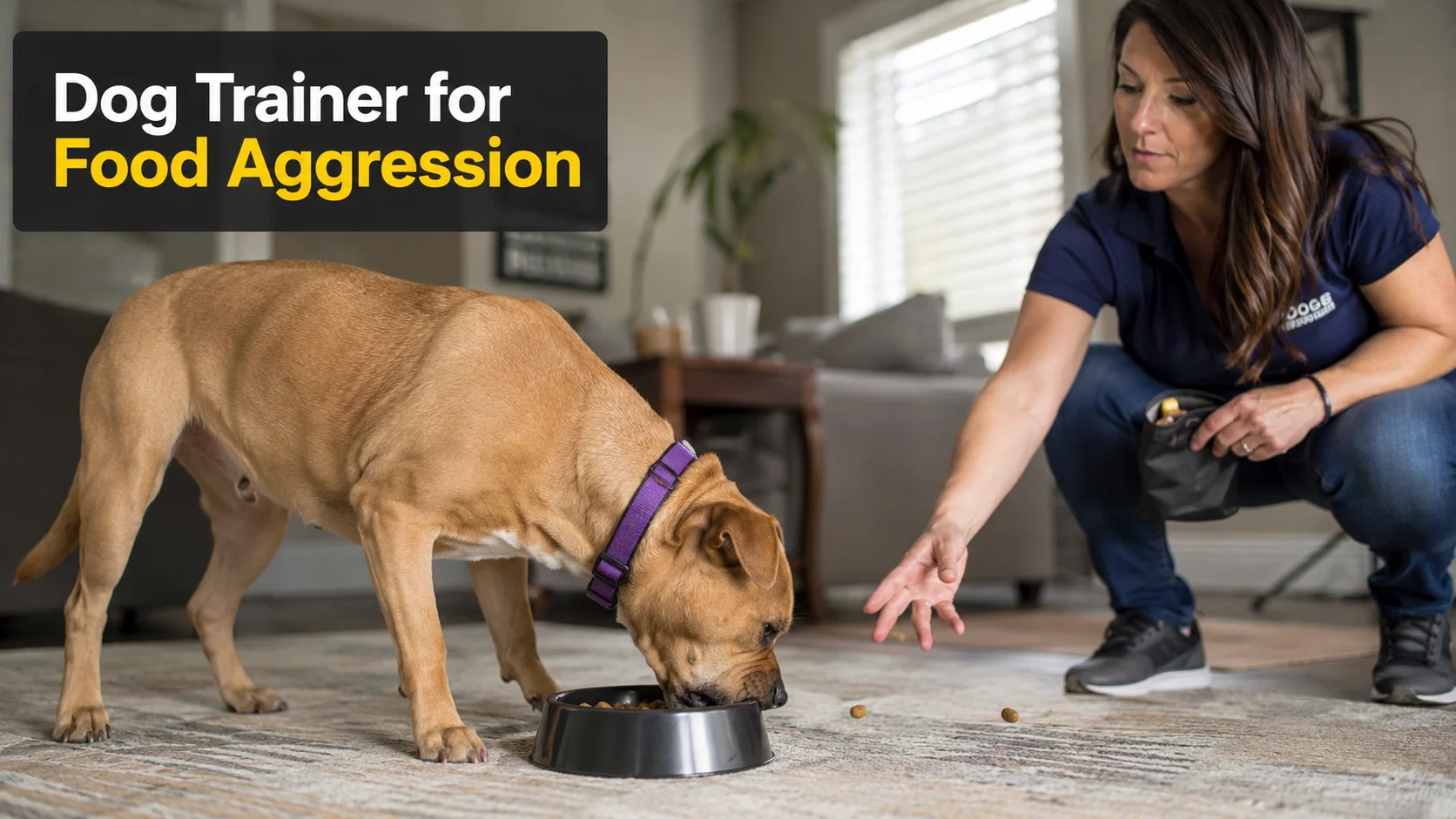
Quick Answer
A dog trainer for food aggression helps dogs that guard food, treats, chews, or feeding areas by using reward-based behavior modification techniques. The safest approach focuses on management, desensitization, counter-conditioning, and preventing situations that trigger guarding behavior. Severe cases may require help from a qualified trainer or veterinary behaviorist to reduce the risk of bites and improve safety.
Introduction
Few dog behavior problems create as much anxiety for owners as food aggression. A dog that growls when someone approaches their food bowl, snaps when a family member walks nearby, or guards a favorite chew can make everyday routines stressful and unpredictable.
Many owners immediately assume their dog is trying to be dominant or stubborn. In reality, food aggression is usually a form of resource guarding. The dog is attempting to protect something they consider valuable because they fear losing access to it.
The good news is that many dogs can learn safer and more relaxed behaviors through structured training. A qualified dog trainer for food aggression can help identify triggers, develop a behavior modification plan, and teach both the dog and owner how to manage situations safely.
Whether you have a puppy showing early signs of food guarding or an adult dog with a history of aggressive behavior around food, understanding why the behavior happens is the first step toward improvement.
This guide explains what food aggression means, common warning signs, safety rules, step-by-step training methods, mistakes to avoid, and when professional help is necessary.
What Dog Trainer For Food Aggression Means
A dog trainer for food aggression specializes in helping dogs that display defensive or aggressive behavior around food and other valuable resources.
These professionals often work with:
- Food bowl guarding
- Treat guarding
- Bone guarding
- Resource guarding between dogs
- Guarding food from family members
- Multi-dog household conflicts
- Related aggression issues
Rather than focusing on punishment, experienced trainers concentrate on changing the dog’s emotional response.
The goal is not simply to stop growling.
The goal is to help the dog feel safer and less worried about losing resources.
Resource Guarding vs Food Aggression
While many owners use the term “food aggression,” trainers often use the broader term “resource guarding.”
Resource guarding can involve:
- Food bowls
- Treats
- Toys
- Beds
- Furniture
- Favorite people
- Stolen household objects
Food aggression is simply one form of resource guarding.
Understanding this distinction helps owners recognize patterns that may affect other areas of their dog’s behavior.
Why Dogs Become Food Aggressive
Understanding the cause of the behavior is essential before beginning any training plan.
Natural Survival Behavior
Dogs evolved to protect valuable resources.
While domestic dogs no longer need to compete for survival in most homes, some still have strong instincts to protect food.
Genetic Influences
Certain dogs naturally place a higher value on resources.
This does not mean a breed is aggressive. It simply means some dogs may be more sensitive about valuable items.
Early Life Experiences
Dogs that experienced competition around food during puppyhood may be more likely to guard resources later.
Examples include:
- Large litters
- Shelter environments
- Inconsistent feeding schedules
- Previous food scarcity
Fear And Anxiety
Many food aggressive dogs are actually fearful rather than dominant.
They may believe:
“If someone comes near my food, I might lose it.”
Training focuses on replacing that fear with positive expectations.
Learned Behavior
Sometimes owners accidentally reinforce guarding.
For example, if a dog growls and the person immediately leaves, the dog learns that growling successfully protects the resource.
Over time, the behavior can become stronger.
Medical Causes
Pain and illness can contribute to aggression.
Dogs experiencing discomfort may become more defensive around resources.
Schedule a veterinary examination if:
- Aggression appears suddenly
- Behavior worsens unexpectedly
- Appetite changes occur
- Other unusual symptoms appear
Common Triggers And Warning Signs
Food aggression rarely appears without warning.
Dogs usually communicate discomfort long before a bite occurs.
Common Triggers
Food-aggressive dogs may react when:
- Someone approaches their bowl
- A hand reaches toward food
- Another dog comes near
- Children move around feeding areas
- Someone attempts to remove a chew
- Food is taken away repeatedly
- Feeding occurs in a crowded environment
Early Warning Signs
Many owners miss subtle signals.
Look for:
- Eating faster than usual
- Tension in the body
- Freezing over food
- Hard staring
- Side-eye glances
- Raised lips
- Low growling
Advanced Warning Signs
As stress increases, behavior may escalate to the following:
- Snapping
- Lunging
- Air snapping
- Biting
- Chasing another dog away
Recognizing early signals allows intervention before behavior becomes dangerous.
Never Punish Growling
Growling is communication.
A growl tells you the dog is uncomfortable.
Punishing growling may suppress the warning signal while leaving the underlying concern unchanged.
This can increase bite risk because the dog may stop warning before reacting.
Safety Rules Before Training
Important Safety Notice
Food aggression can lead to serious bites.
If your dog has already bitten someone, seek professional assistance before attempting behavior modification on your own.
Children should never participate in aggression training exercises.
Rule 1: Stop Testing The Dog
Many owners repeatedly approach the food bowl to “see if the dog still growls.”
This often makes guarding worse.
Avoid creating unnecessary confrontations.
Rule 2: Manage The Environment
Management reduces opportunities for mistakes.
Examples include:
- Feeding in separate rooms
- Using baby gates
- Feeding in crates
- Creating quiet feeding zones
Rule 3: Separate Dogs During Meals
Competition between dogs frequently increases guarding behavior.
Separate feeding locations reduce tension and conflict.
Rule 4: Protect Children
Children often move unpredictably and may not recognize warning signals.
Keep feeding areas completely separate from children’s activities.
Rule 5: Use Safety Equipment When Necessary
In severe cases, a professional trainer may recommend muzzle conditioning.
A properly fitted basket muzzle can
- Improve safety
- Reduce risk during training
- Allow panting and drinking
A muzzle should never be used as a substitute for training.
Understanding Trigger Distance And Threshold
Two important concepts in dog aggression training are trigger distance and threshold.
What Is Trigger Distance?
Trigger distance is the point at which the dog begins reacting.
For example:
- Relaxed at 12 feet
- Slight tension at 8 feet
- Growling at 5 feet
The trigger distance lies somewhere between those distances.
Training should begin outside the trigger distance.
What Is Threshold?
“Threshold” refers to the point where a dog becomes too stressed to learn effectively.
Signs of being over the threshold include the following:
- Barking
- Lunging
- Growling
- Refusing treats
- Hypervigilance
- Inability to focus
Training is most effective when the dog remains below the threshold.
Keeping the dog under the threshold is one of the most important principles in behavior modification.
Why Professional Trainers Use Desensitization and Counter-Conditioning
Modern dog aggression training relies heavily on these proven behavior modification techniques.
Desensitization
Desensitization involves exposing the dog to a trigger at a level that does not provoke a strong reaction.
The exposure is gradual and controlled.
Counter-conditioning
Counter conditioning changes the dog’s emotional response.
Instead of thinking:
“People approaching my food are bad.”
The dog learns:
“People approaching my food predict amazing rewards.”
This emotional shift is often the foundation of successful food guarding treatment.
Step-by-Step Behavior Plan For Food Aggression
Step 1: Create A Safe Feeding Environment
Choose a calm location where the dog can eat without interruptions.
Suitable locations include the following:
- Separate rooms
- Crates
- Exercise pens
- Gated areas
The objective is reducing stress while eating.
Step 2: Determine The Comfort Distance
Observe from far enough away that the dog remains relaxed.
Signs of relaxation include:
- Normal eating pace
- Soft body language
- No freezing
- No staring
- No growling
This becomes the starting point for training.
Step 3: Approach And Toss High-Value Treats
Walk toward the dog from a safe distance.
Toss a highly desirable treat into the bowl.
Examples include:
- Chicken
- Turkey
- Cheese
- Freeze-dried liver
Then walk away.
The approach predicts something better rather than loss of food.
Step 4: Repeat Short Sessions
Keep sessions brief.
A few successful minutes are more valuable than a long stressful session.
Aim for:
- 3 to 5 minutes
- Several times weekly
- Consistent practice
Step 5: Gradually Decrease Distance
As the dog becomes more comfortable, reduce the distance slightly.
Always monitor body language.
If tension appears, increase distance again.
Step 6: Build Positive Expectations
Eventually many dogs begin looking up happily when someone approaches.
This change in emotional response is a major training milestone.
Step 7: Generalize The Training
Practice safely in:
- Different rooms
- Various feeding setups
- Different family members
- Different food types
Generalization helps create reliable behavior in everyday situations.
Common Mistakes That Make Food Aggression Worse
Many owners unintentionally increase guarding behavior despite having good intentions. Understanding these mistakes can prevent setbacks and improve training progress.
Taking Food Away Repeatedly
One of the most common pieces of outdated advice is to regularly remove a dog’s food bowl to show who is in charge.
Unfortunately, this often teaches the dog the exact lesson you do not want them to learn:
“Humans approaching my food make it disappear.”
Over time, the dog may become more defensive because their concern about losing food has been confirmed.
A better approach is teaching that people approaching food bring something even better.
Punishing Growling
Growling is valuable communication.
A growl is often the dog’s way of saying the following:
“I’m uncomfortable.”
“I’m worried.”
“Please give me space.”
Punishing the growl may suppress the warning without addressing the emotion behind it.
The result can be a dog that skips warning signs and moves directly to snapping or biting.
Moving Too Quickly
Owners are often eager to see results.
However, reducing distance too fast can push the dog over threshold.
Behavior modification is rarely a race.
Slow progress is usually more reliable than rapid progress.
Training Around Too Many Distractions
A dog learning new behaviors needs an environment where they can focus.
Avoid beginning training:
- Around visiting guests
- During family meals
- Around children
- Around other dogs
- In busy outdoor areas
Start in a controlled setting and gradually increase difficulty.
Inconsistent Household Rules
Food aggression training works best when everyone follows the same plan.
Problems occur when:
- One family member tosses treats
- Another takes food away
- One person respects boundaries
- Another challenges the dog
Consistency creates predictable outcomes for the dog.
Signs That Training Is Working
Progress can be subtle at first.
Many owners expect dramatic changes and miss important improvements.
Early Signs Of Success
Look for:
- Less body tension
- Slower eating
- Reduced staring
- Softer facial expression
- Willingness to continue eating while someone is nearby
Intermediate Signs Of Success
As confidence improves, you may notice:
- Relaxed body posture
- Looking toward people expectantly
- Wagging tail when someone approaches
- Improved response to cues around food
Advanced Signs Of Progress
Eventually, many dogs:
- Stay relaxed around approaching family members
- Remain calm when people move through the room
- Show little concern about nearby activity
- Recover quickly from mild stressors
Remember that progress is rarely perfectly linear.
Some days will be better than others.
A Practical Daily Training Routine
Consistency is more important than marathon training sessions.
A realistic daily routine might look like this.
Morning
Feed breakfast in a quiet location.
Observe body language without interacting.
Look for:
- Relaxed posture
- Comfortable eating speed
- Absence of guarding signals
Midday
Conduct a short training session.
Duration:
- Three to five minutes
Activity:
- Approach from safe distance
- Toss high-value treats
- Walk away
Repeat several times.
Evening
Practice around a chew toy or food puzzle.
Continue creating positive associations with approaching people.
Record observations in a training journal.
Weekly Review
At the end of each week, Evaluate:
- Trigger distance
- Stress signals
- Recovery time
- Overall comfort level
Small improvements add up over time.
Food Aggression In Puppies
Many people assume puppies cannot develop guarding behavior.
Unfortunately, resource guarding can appear surprisingly early.
Early Signs In Puppies
Watch for:
- Stiffening around food
- Hovering over bowls
- Growling during meals
- Guarding treats
- Defending toys
Early intervention is often easier than treating a long-established behavior pattern.
Safe Puppy Training
Reward-based methods can help puppies develop positive associations with human presence.
Examples include:
- Tossing treats into the bowl while walking by
- Trading low-value items for better rewards
- Teaching cooperative behaviors
Avoid creating situations where the puppy feels the need to defend resources.
Socialization Matters
Proper socialization helps puppies build confidence and resilience.
However, socialization does not mean forcing interactions.
Positive experiences are far more important than the number of experiences.
Food Aggression In Adult Dogs
Adult dogs often require a more structured approach.
The behavior may have been practiced for months or years.
Why Adult Dogs Guard Food
Common reasons include:
- Reinforced guarding behavior
- Previous competition for resources
- Anxiety
- Learned experiences
- Genetic predisposition
Expectations For Adult Dogs
Improvement is possible, but timelines vary.
Factors affecting progress include:
- Severity of guarding
- Bite history
- Training consistency
- Household management
- Underlying emotional state
Many adult dogs show meaningful improvement through systematic training.
Multi-Dog Household Challenges
Resource guarding often becomes more complicated when multiple dogs live together.
Common Problems
Owners may see:
- Staring contests
- Blocking access to food
- Chasing other dogs away
- Fights near feeding areas
- Guarding chews and toys
Management Strategies
Feed dogs separately.
Use:
- Different rooms
- Crates
- Baby gates
- Exercise pens
Remove leftovers after meals.
Monitor interactions around valuable resources.
Why Management Matters
Management is not failure.
Management prevents rehearsal of unwanted behavior while training progresses.
Food Aggression And Fear Aggression
Some dogs that guard food also display fear-based behaviors in other situations.
Examples include:
- Barking at strangers
- Retreating from unfamiliar people
- Defensive reactions during handling
- Sensitivity to sudden movements
Understanding Fear Aggression
Fear aggression develops when a dog feels threatened.
The goal is often creating distance from the perceived threat.
Shared Training Principles
Food aggression and fear aggression frequently benefit from:
- Desensitization
- Counter-conditioning
- Trigger management
- Positive reinforcement
- Building confidence
Addressing the emotional state behind the behavior is often more effective than correcting the outward reaction.
Food Aggression And Leash Reactivity
Some owners searching for dog aggression training discover their dog also reacts on walks.
Leash reactivity and food guarding may appear unrelated, but they share several characteristics.
Common Similarities
Both behaviors often involve:
- Emotional responses
- Trigger thresholds
- Distance sensitivity
- Stress accumulation
Training Overlap
Successful plans typically include:
- Managing exposure
- Working below threshold
- Rewarding calm behavior
- Gradually increasing difficulty
Dogs that improve in one area often benefit from the same learning principles elsewhere.
Can you train aggression out of a dog?
This is one of the most frequently asked questions about dog aggression training.
The honest answer is
Sometimes.
But not always completely.
Factors That Influence Outcomes
Results depend on:
- Genetics
- Learning history
- Severity of behavior
- Bite history
- Environment
- Consistency of training
- Professional support
What Success Usually Looks Like
Success may mean:
- Fewer aggressive responses
- Reduced intensity
- Better coping skills
- Improved safety
- Greater predictability
For some dogs, long-term management remains part of the solution.
That does not mean training failed.
It means the owner’s expectations align with the dog’s individual needs.
How Long Does Food Aggression Training Take?
There is no universal timeline.
Mild Cases
Some mild guarding behavior improves within several weeks.
Moderate Cases
Many moderate cases require several months of structured training.
Severe Cases
Dogs with significant bite histories or intense guarding behavior may require ongoing management and long-term professional guidance.
Factors affecting speed include:
- Frequency of practice
- Quality of management
- Severity of guarding
- Household consistency
- Presence of other behavior issues
Patience is essential.
Rushing the process often creates setbacks.
When Professional Help Is Needed
While mild cases can sometimes improve with owner education, some situations require professional assistance immediately.
Seek help if:
- Your dog has bitten someone
- Children live in the home
- Aggression is escalating
- Multiple resources are guarded
- The dog guards food from family members
- The dog redirects aggression
- You feel unsafe
What To Look For In A Trainer
Choose someone experienced with:
- Resource guarding
- Aggression cases
- Behavior modification
- Positive reinforcement training
Ask questions such as:
- What methods do you use?
- How do you address food aggression?
- What safety protocols do you recommend?
- Do you use punishment-based techniques?
Look for trainers who focus on behavior change rather than intimidation.
Dog Aggression Training Cost
Many owners wonder how much professional help will cost.
Prices vary based on:
- Geographic location
- Trainer experience
- Session length
- Complexity of the case
- Private versus group training
Aggression cases generally cost more than basic obedience lessons because they require individualized planning and risk management.
While cost matters, experience with aggression cases should be a priority when choosing professional support.
Red Flags When Choosing A Trainer
Not every trainer is qualified to work with aggression.
Be cautious of a trainer:
- Promises instant results
- Guarantees a cure
- Uses fear-based methods
- Focuses on dominance theories
- Encourages provoking aggressive reactions
- Suggests punishing warning signs
Aggression work requires careful planning and safety considerations.
Reliable trainers discuss realistic expectations and long-term management when necessary.
Advanced Behavior Modification Tips For Food Aggression
Once a dog is showing consistent improvement, owners can begin working on more advanced exercises under safe conditions. These exercises should only be introduced when the dog remains relaxed during the foundational stages of training.
Teach A Reliable “Trade” Cue
A trade cue teaches your dog that giving up an item leads to an even better reward.
For example:
- Offer a low-value toy.
- Present a high-value treat.
- Say “trade.”
- Reward immediately when the dog releases the item.
- Return the original item whenever possible.
This helps build trust and reduces anxiety about losing resources.
Build Positive Associations Around Movement
Some dogs react when people walk past while they are eating.
Practice moving through the room while calmly tossing treats toward the dog from a safe distance.
The goal is to teach:
“People moving nearby make good things happen.”
Practice Around Different Resources
Resource guarding may not be limited to food.
As training progresses, carefully assess behavior around:
- Chews
- Toys
- Beds
- Stolen objects
- Resting places
Each resource may require its own training plan.
Strengthen Foundation Behaviors
Useful skills include:
- Leave it
- Drop it
- Place
- Stay
- Recall
- Mat training
These obedience behaviors do not replace behavior modification, but they can improve communication and management.
Dog Body Language Every Owner Should Know
Learning canine body language can dramatically improve training success.
Relaxed Signals
Signs of comfort include:
- Loose muscles
- Soft eyes
- Normal breathing
- Relaxed ears
- Natural tail movement
Mild Stress Signals
Early stress signs may include:
- Lip licking
- Yawning
- Looking away
- Turning the head
- Slow movement
Serious Warning Signs
Pay attention to:
- Freezing
- Hard staring
- Raised lips
- Growling
- Snapping
- Lunging
Intervening early is safer and more effective than waiting for escalation.
Food Aggression Safety Checklist
Use this checklist regularly during training.
Household Safety
- Feed in a quiet location.
- Prevent interruptions during meals.
- Separate dogs while eating.
- Supervise interactions around food.
- Remove leftover food promptly.
Training Safety
- Stay below threshold.
- Use high-value rewards.
- Avoid punishment.
- Keep sessions short.
- Monitor body language carefully.
Family Safety
- Educate all family members.
- Create consistent rules.
- Keep children away from training exercises.
- Follow the same management plan.
Professional Support
- Seek help if bites occur.
- Contact a qualified trainer for severe cases.
- Consult a veterinarian if behavior changes suddenly.
Sample Weekly Training Schedule
Monday
- Breakfast observation
- 5-minute treat-toss session
- Evening relaxation exercise
Tuesday
- Controlled feeding session
- Approach-and-reward practice
- Short obedience review
Wednesday
- Rest day from structured training
- Continue management strategies
Thursday
- Food bowl desensitization session
- Positive reinforcement exercises
Friday
- Practice with different family member
- Reward calm responses
Saturday
- Review trigger distance
- Journal training progress
Sunday
- Easy success-focused session
- Evaluate improvements and adjust goals
Consistency over several weeks often produces better results than intense training performed occasionally.
Conclusion
Living with a food-aggressive dog can be stressful, but the behavior is often more manageable than many owners initially believe. In most cases, resource guarding develops from fear, insecurity, learned experiences, or a strong desire to protect valuable resources rather than a desire to dominate people.
A qualified dog trainer for food aggression can help identify triggers, improve safety, and create a structured behavior modification plan based on positive reinforcement, desensitization, and counterconditioning. Progress takes patience, consistency, and realistic expectations, but many dogs learn to feel significantly more comfortable when people are near their food.
Frequently Asked Questions
Can food aggression develop suddenly?
Yes. Sudden food aggression may be linked to stress, environmental changes, pain, illness, or other medical issues. If the behavior appears unexpectedly, schedule a veterinary examination before assuming it is strictly a training problem.
Is food aggression more common in certain breeds?
Resource guarding can occur in any breed, mixed breed, age group, or size of dog. Individual temperament, genetics, learning history, and environment usually play a larger role than breed alone.
Should I hand-feed a food-aggressive dog?
Hand-feeding is not automatically appropriate for every dog. In some cases it can help build positive associations, while in others it may increase stress. A qualified professional can determine whether hand-feeding fits your dog’s training plan.
Can neutering or spaying stop food aggression?
Food aggression is primarily a behavioral issue. Spaying or neutering alone is unlikely to eliminate resource guarding. Training, management, and behavior modification remain the primary solutions.
What is the difference between food aggression and possessive aggression?
Food aggression specifically involves guarding food-related resources. Possessive aggression or resource guarding may involve toys, beds, chews, stolen objects, furniture, or even preferred people.
Can multiple dogs be trained together?
In most cases, training should begin individually. Working with one dog at a time allows better control of the environment and reduces competition around resources.
Is a growl always a bad sign?
No. Growling is communication. It provides information about the dog’s emotional state and discomfort level. While it should be taken seriously, it should not be punished.
How do I know if I need a veterinary behaviorist?
A veterinary behaviorist may be helpful when aggression is severe, escalating, linked to anxiety disorders, associated with a bite history, or not responding to standard behavior modification programs.